Operations Research · Supply Chain
Inventory & Supply Chain Optimization
An end-to-end optimization project combining inventory planning, service-level analysis, and transportation optimization to improve stocking decisions and distribution efficiency.
Focus
Inventory & Logistics Optimization
Tools
Python · Excel · PuLP
Methods
EOQ · Safety Stock · Linear Programming
01 · The Problem
Balancing inventory availability with operational cost.
Supply chain decisions involve a constant trade-off: holding too much inventory increases carrying costs, while holding too little increases the risk of stockouts and poor service levels.
This project models that trade-off across multiple products and extends the analysis to distribution — determining how inventory should be allocated and transported across locations while minimizing overall logistics cost.
Objective
Build a data-driven inventory and transportation optimization system that improves service levels while controlling inventory and distribution costs.
02 · The Approach
From inventory planning to distribution optimization.
The project was structured as a three-stage optimization workflow, connecting inventory decisions with service-level requirements and transportation planning.
01
Inventory Optimization
Evaluated inventory requirements across 5 SKUs using demand, ordering cost, holding cost, and lead-time information.
02
Service-Level Analysis
Tested service levels from 90% to 98% to understand the trade-off between inventory availability and additional safety stock.
03
Transportation Optimization
Applied linear programming to determine shipment allocations across the supply network while minimizing transportation cost.
03 · Key Results
Turning the analysis into measurable outcomes.
The optimization framework connected inventory planning with service-level decisions and transportation allocation, producing actionable insights across the supply chain.
5
SKUs optimized
Inventory decisions evaluated across multiple products.
90–98%
Service levels evaluated
Compared inventory requirements across different service targets.
24.7%
Transportation cost reduction
Achieved through optimized shipment allocation across the network.
04 · Optimization Output
From model decisions to shipment allocation.
The final transportation model determines how units should move between supply locations and destinations while minimizing total distribution cost.
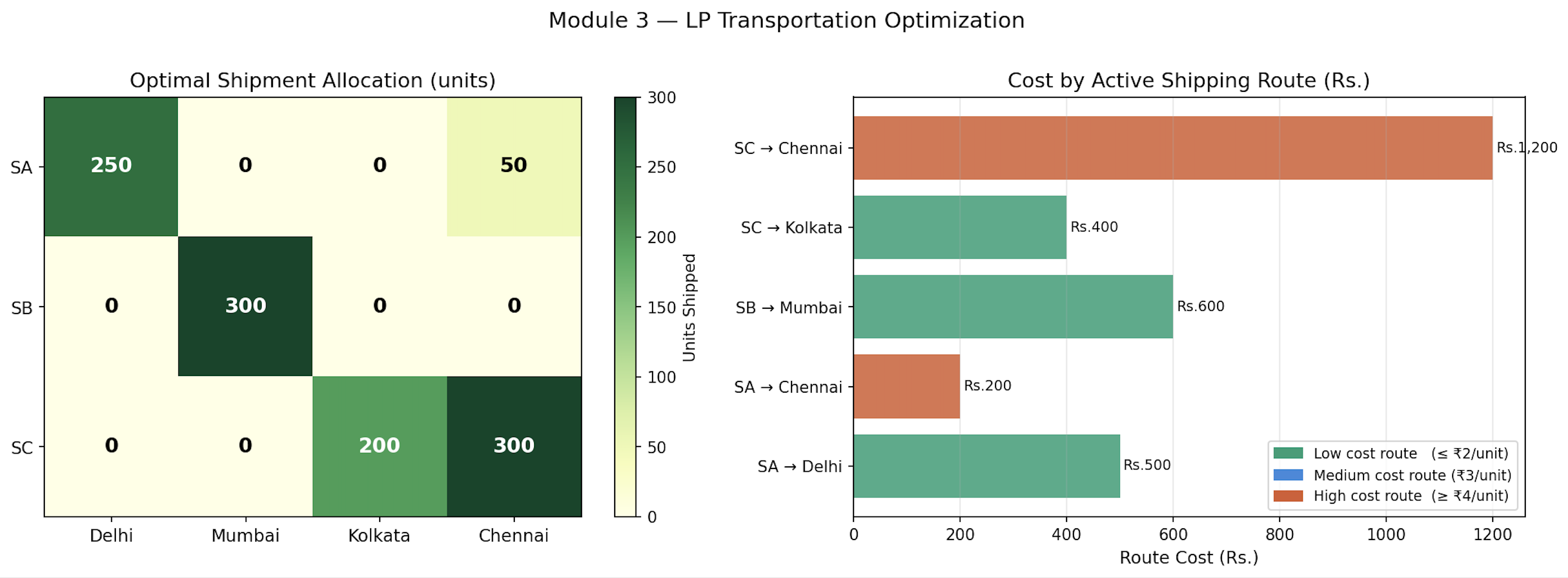
Optimized shipment allocation and transportation cost across active routes.
Explore the Project
Want to see the complete analysis and implementation?
Explore the full project repository for the code, methodology, datasets, calculations, and detailed results.